

She had drafted the email to the recruiter before she ever called me. Subject line written, role identified, the move mapped clean in her head. A bigger title, a wider span, a company with a name people recognize. By every measure, she had spent her career learning to read; it was the right next step.
Then I asked her one question, and the room went quiet for a long time.
“What is this move for?”
Not what does it pay. Not what title comes with it. Not what people will think when you get it.
What is it actually for?
She is one of the sharpest leaders I know. She could walk me through the logic behind any decision on her calendar that week. But this question, the smallest one in the room, was the one she could not answer.
Here is what I know for sure after years of sitting with people at the top of their fields: what stalls high achievers is almost never a shortage of options. They are drowning in options. What stalls them is using the wrong discipline to choose among them.
A pivot and a design are not the same project
Career strategy answers the question “what next?” It lives inside the domain of work: positioning, leverage, timing, fit. Which role, which company, which move compounds the value of the last one. It is a real skill, and high performers are very good at it. They have been optimizing this one variable their entire adult lives.
Life design answers a different question: “What for?” It is the larger architecture, and in it, work is one room in the house rather than the house itself. The other rooms (your relationships, your health, your money, your sense of meaning, the way you spend your one finite supply of time) belong to the same blueprint. Career strategy optimizes a single variable. Life design holds them all together and asks whether the whole composition coheres.
You can be brilliant at the first and have never once practiced the second. Most accomplished people have not, because the first is the lever their hand reaches for automatically. Twenty-five years of solving for the career variable will do that. Then, eventually, restlessness arrives. Not because anything is wrong. Often, life looks successful from the outside. The role is respected. The compensation is good. The career is working exactly as designed. And yet something feels incomplete. The instinct is to treat that feeling as a career problem. I need a new challenge. A bigger role. A different company. So you pivot.
But a life-design question wearing a career-strategy costume will not be answered by a career-strategy move.
Run the test before you draft the email
Before you reach for the recruiter, give yourself ten quiet minutes and three questions. Answer them honestly, not strategically.
One. If your title and your income stayed exactly the same for the next three years, would this restlessness go away? If the honest answer is no, you are holding a design question, not a strategy one.
Two. Can you describe what “better” actually looks like in specifics, beyond “not this”? If you cannot, you do not yet have a target. You have an exit.
Three. Does the dissatisfaction live only at work, or has it shown up at home, in your health, on your Sunday nights? If it is everywhere, the role is not the cause.
Two or three honest “design” answers, and the pivot is not your next step. The pivot is the thing you do after you have done the real work, not instead of it.
What changes when you design instead of pivot
You start with the self, not the options. Career strategy begins with what is available and what pays. Life design begins with what is true: what you want this decade of your life to be about, what you are no longer willing to trade, what your True North is now that it has quietly moved. The question of what is available comes second, and it is a far better question once the first one has an answer.
You hold the whole composition. A move that is excellent for your career and corrosive to everything around it is not a good move. You stop grading opportunities on a single axis and start asking whether each one belongs in the life you are actually building.
You think in arcs, not jumps. A pivot is a single step. A design is a trajectory. The most intentional leaders I work with are not asking, “What is my next job?” They are asking “what do I want the next seven to ten years to add up to,” and letting that longer arc tell them which next step belongs in the story.
What the restlessness is really telling you
A career pivot can be one of the most freeing moves you ever make. It is not the enemy. The enemy is the pivot performed as a substitute for the harder, quieter work of deciding what your life is for.
And this is not only true of careers. The same confusion shows up in our relationships, in what we choose to study, and in where we decide to live. We leave one partnership for another, add the next credential, move to the next city, and carry the same restlessness right along with us. The domain changes. The diagnostic does not. Anywhere the honest answer to “would changing this make the restlessness go away?” is no, you are likely holding a design question dressed up as a tactical one.
So when you feel the pull toward a change, slow down long enough to ask which discipline the moment is actually asking for. Sometimes you genuinely need a new role, and the strategy is sound, and you should go. And sometimes the restlessness is not asking you to move at all.
The restlessness is not a flaw in your ambition. It is information. It is the most honest part of you, telling you that something in your life no longer fits and asking you to reconsider. Sometimes the answer is a new role. Sometimes it is a new way of living. The work is knowing the difference. A pivot changes your answer. A design changes the question. You are not lost. You are being asked to choose, on purpose and out loud, what this one extraordinary life is for.
That choice was always yours. The restlessness is simply the part of you that already knew.
Before you change jobs, make sure the job is actually the problem.
“A pivot changes your answer. A design changes the question.”
This Is What The Bridge Is For
You do not need to have the full answer yet. But you do deserve a space to think clearly about the question before someone else’s agenda, urgency, or expectations answer it for you.
This work does not have to be lonely.
If you are somewhere between I’m not done and I need to know what’s next, The Bridge: A Harmonious Leadership Playbook™ was created for exactly this moment – a starting place for women leaders ready to stop circling the question and begin moving toward what comes next.
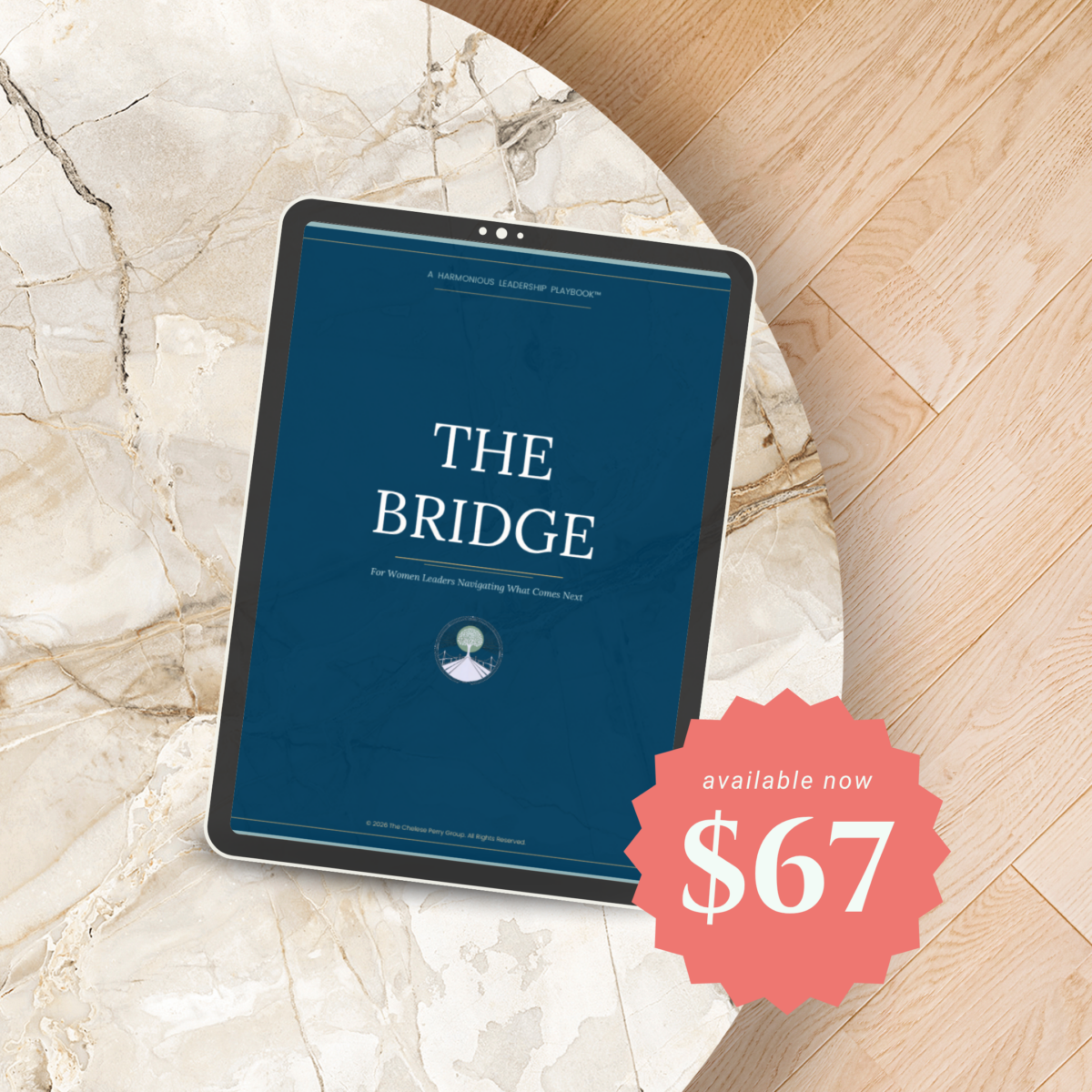
If you’re ready to stop circling the question of what’s next and start moving toward it, I’ve created The Bridge: A Harmonious Leadership Playbook as a starting point.
Because this work deserves more than insight.
It deserves direction.
Chelese Perry is a Professional Certified Coach (PCC) and founder of The Chelese Perry Group. Her Harmonious Leadership Circles™ and Harmonious Leadership frameworks help leaders align their values, purpose, and deepest wisdom with their authentic path forward.
She partners with senior leaders navigating pivotal transitions, supporting them in moving from pressure and uncertainty to clarity, confidence, and aligned action.
She works with women leaders through Harmonious Leadership Circles™ and coaches senior executives through personalized 1:1 Executive Coaching Programs.