
You’ve earned this.
The vacation was planned months ago. The out-of-office is on. Your team knows what to do.
And yet…
Somewhere over the Atlantic, or sitting on a beach, or in the first quiet Saturday morning you’ve had in months, you feel it. The low hum of anxiety that has no object. The pull toward your phone. The vague, formless sense that something needs your attention, even when nothing does.
This is not a discipline problem. It is not ingratitude. It is not a sign that you love your work too much.
It is your nervous system doing exactly what years of high-performance leadership trained it to do, and it doesn’t know how to stop just because you told it to.

This isn’t a personal failing.
It isn’t a lack of willpower or a character flaw.
For high-achieving leaders, the inability to rest is a physiological pattern, one that gets wired in over years of high-performance living.
Your nervous system learned a very specific lesson: output equals safety. Doing equals worth. The moment you stop moving, something in your body sounds a quiet alarm.
And the cost isn’t just personal. Leaders running on a chronically activated nervous system make more reactive decisions, read rooms less accurately, and lose access to the very qualities (presence, strategic clarity, genuine connection) that make them effective at the highest levels. The exhaustion you’re managing privately is shaping every room you walk into.
“For most high achievers, rest doesn’t feel like recovery. It feels like risk.”
I know this not just as a coach, but from the inside.
My Own Relationship with Full Throttle
For most of my adult life, I was afraid to stop. Not afraid in a way I could have named back then, but afraid in the deepest, most cellular sense. I believed, somewhere below conscious awareness, that if I let myself truly relax, I wouldn’t be able to find my way back. That I’d lose the edge. That the version of me who could do it all would simply disappear if I stopped long enough to breathe.
I carried this fear through my corporate career, through motherhood, through the early years of building my business. Full throttle wasn’t a pace I chose. It was a posture I couldn’t leave. Every season of my life had its own version of the same story: keep moving, keep producing, keep proving. Rest was something that happened to other people, or something you earned at the end, once everything was done. And everything was never done.
In more recent years, I thought I had found my way to stillness. I had the language for it. I spoke about harmony, about sustainability, about leading from wholeness. I meditated. Sometimes. I took vacations. Occasionally. But if I’m honest, I was practicing the performance of stillness. Going through the motions of rest without actually inhabiting it. My body would go still, but my nervous system never did.
Then, at the beginning of this year, I broke my shoulder.
What happened during my recovery wasn’t a revelation. It was a confirmation. A confirmation of work I had already been doing, in both practice and intention, for years. The frameworks I built, the conversations I held with clients, the language I had developed around harmony and wholeness: all of it was real. The shoulder break didn’t expose a gap in my practice. It gave me the stillness to go deeper into it than I had ever allowed myself to go before.
What I came face-to-face with was something I now call my dis-ease with stillness, not a typo, but a deliberate distinction. Not discomfort with it: dis-ease. A deep, patterned unease that had been quietly running underneath all the progress I’d made. But here is what I also know now: that unease had been loosening its grip for years. The recovery didn’t create the work. It let me take it all the way in.
And there is something else that has made this deepening possible. My business is now eight years old. The young adults I raised are finding their own footing in the world. The season of maximum demand, the one that required me to be everything to everyone at all times, has shifted. What I feel now, in its place, is spaciousness. Not emptiness. Spaciousness. Room to be still without it meaning something is wrong. Room to rest without it costing something I can’t afford to lose. I didn’t manufacture this opening. I built toward it, and then I let myself walk through it.

The Wiring Beneath the Drive
The autonomic nervous system operates in two primary modes: the sympathetic state (what we call “fight or flight”) and the parasympathetic state, often called “rest and digest.” High achievers spend years, sometimes decades, training their nervous systems to live in the first mode.
Think about what got you here. The early mornings. The late nights. The ability to push through when others stepped back. The resilience that became your calling card. That capacity was real. It served you. But over time, the nervous system stops treating performance as a choice and starts treating it as the baseline for safety.
When stillness arrives, the body doesn’t register it as relief. It registers it as unfamiliar, and unfamiliar can trigger the same circuitry as threat.
Signs your nervous system is stuck in performance mode:
- You feel anxious or irritable during unstructured time
- Rest produces guilt rather than replenishment
- You find yourself manufacturing urgency where none exists
- Your body is exhausted, but your mind won’t slow down
The Productivity Identity
 Here’s where it gets layered: for many senior leaders, productivity isn’t just a behavior. It’s an identity. Over time, “doing” and “being” collapse into one another. Who you are becomes inseparable from what you produce.
So when rest asks you to simply be, without a deliverable, without a role, without a result, and the nervous system reads that as a kind of erasure.
Not rest.
Loss.
At the senior leader level, this shows up in specific ways. It’s the executive who can’t delegate because stepping back feels like stepping aside. It’s the CEO who needs to be in every room, not because the work requires it, but because being in the room is how she knows she still matters. It’s the discomfort that surfaces during succession planning, not because the leader doesn’t trust her team, but because somewhere beneath the strategy, she’s not sure who she is without the role. The productivity identity doesn’t just make rest difficult. It makes letting go of any kind of control feel like self-erasure.
This is why willpower doesn’t fix it. You can tell yourself to take a break. You can block time on your calendar. But if your nervous system hasn’t been taught that stillness is safe, no amount of intention will override the signal your body keeps sending.
“You can schedule rest. But you can’t think your way into a regulated nervous system. That requires something slower and more honest.”
You Don’t Have to Break First
Here’s what I want you to hear clearly: you don’t have to wait for a broken shoulder, a health scare, a burnout that takes you offline for months, or any other forced stop to begin this work. I had to learn the hard way. You don’t.
The path back to a regulated nervous system doesn’t require a dramatic turning point. It requires something far more accessible and far more countercultural for high achievers: small, intentional acts of permission. Permission to pause before you’re depleted. Permission to rest before it’s earned. Permission to be still before your body demands it.
This looks different for everyone. For some, it begins with a single Sunday afternoon with no Slack, no email, no “quick check”, sitting with the discomfort of not knowing what’s happening at work until Monday. For others, it’s ending a vacation day without checking in once, not because everything is handled, but as an intentional act of trust in the people they’ve built. For others still, it’s noticing the moment manufactured urgency appears: the Sunday-night pull to send an email that could wait until Tuesday, and deliberately choosing not to act on it.
None of these are grand gestures. But over time, they send a message your nervous system has been waiting years to receive: you are safe here. You don’t have to earn this. You can come back.
The light at the end of this tunnel is real, and it doesn’t require a crisis to reach it. It requires awareness, honesty, and the willingness to practice something new. That, after all, is exactly the kind of work that good leaders already know how to do.

A Different Kind of Leadership Work
The leaders I work with are often surprised to discover that learning to rest is one of the most demanding pieces of growth work they’ll do. Not because rest is complicated, but because it asks them to unlearn a pattern that made them successful for years.
It begins with awareness: noticing the discomfort of stillness without immediately moving to eliminate it. For many leaders, that awareness alone, simply naming the pull toward the phone, the manufactured urgency, the guilt, is the first real act of leadership they’ve turned inward. It continues with small, consistent practices that gradually teach the nervous system that it doesn’t have to earn safety through output.
This is the heart of harmonious leadership. Not the relentless optimization of your output. But the restoration of your capacity, so that when you lead, you’re leading from wholeness, not depletion.
Rest is not the absence of ambition. It is the condition that makes sustained ambition possible.
The leaders who will matter most in the next decade are not the ones who can endure the most. They are the ones who learned, before a crisis forced them, how to come back to themselves. That is the work. And it begins with permission.
At a certain point, awareness alone isn’t enough.
You need a place to work this out in real time.
This Is What The Bridge Is For
You don’t need another leadership framework built for someone else’s career arc. You don’t need to be fixed or reinvented from the outside in.
What you need is a space to think clearly — with other women who understand this particular crossroads. Women who are still hungry and still wondering. Women who know that the most sophisticated leadership move they can make right now is to get honest about what they actually want next — and to start building toward it before anyone else decides for them.
That’s the work. And it doesn’t have to be lonely.
If you’re somewhere between I’m not done and I need to know what’s next — you’re in exactly the right place.
The Bridge was built for this moment.
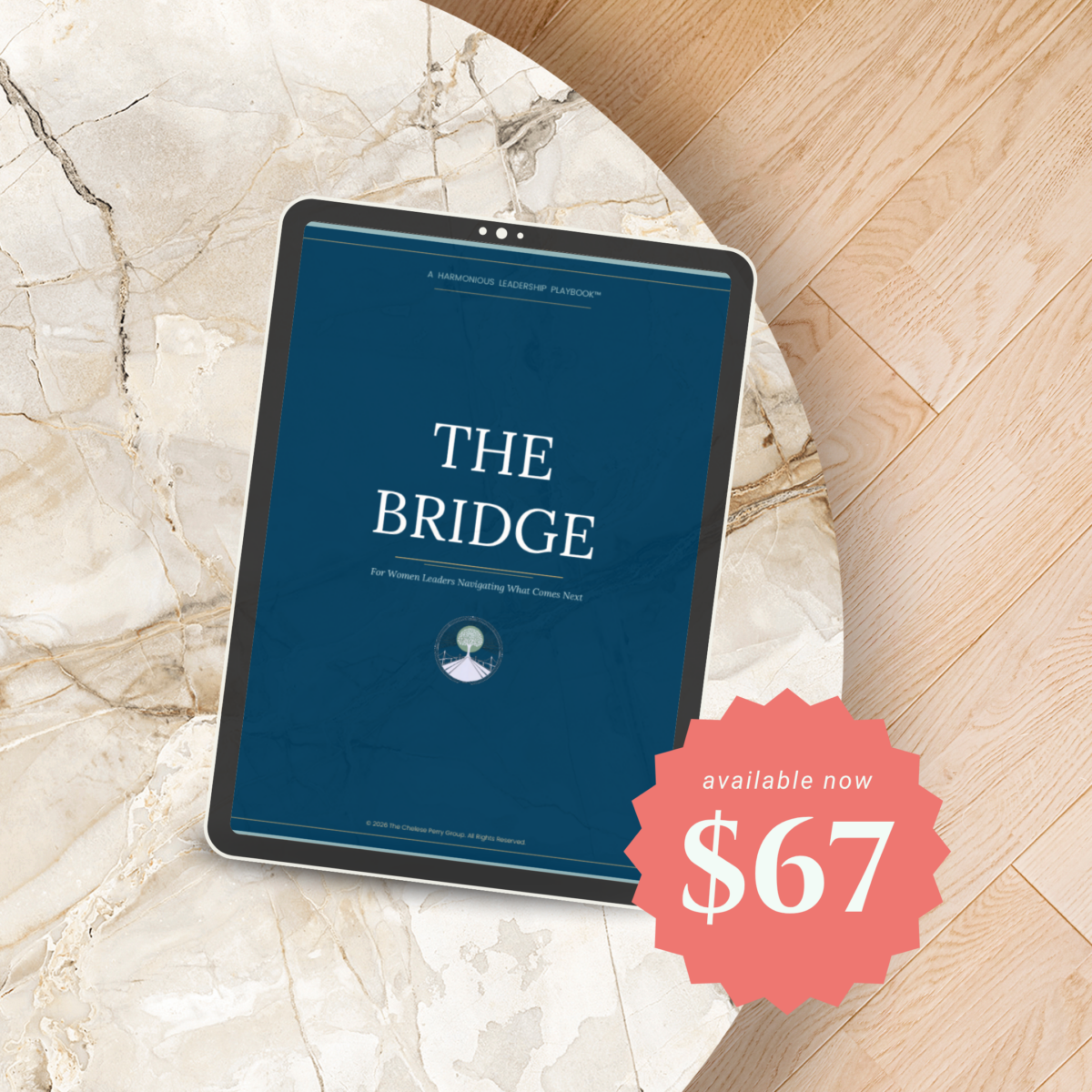
If you’re ready to stop circling the question of what’s next and start moving toward it, I’ve created The Bridge: A Harmonious Leadership Playbook as a starting point.
Because this work deserves more than insight.
It deserves direction.
Chelese Perry is a Professional Certified Coach (PCC) and founder of The Chelese Perry Group. Her Harmonious Leadership Circles™ and Harmonious Leadership frameworks help leaders align their values, purpose, and deepest wisdom with their authentic path forward.
She partners with senior leaders navigating pivotal transitions, supporting them in moving from pressure and uncertainty to clarity, confidence, and aligned action.
She works with women leaders through Harmonious Leadership Circles™ and coaches senior executives through personalized 1:1 Executive Coaching Programs.